

Requirements
If your company does business in California, meaning you have an office, employees, or pay yourself a salary there, you’re required to register with the state.When do you need to register?
Registration is required once your company has a physical presence or economic activity in California. Common triggers:- You or a co-founder live and work in California
- You hire a W-2 employee in the state
- You have a physical office or headquarters there
How to register
Foreign qualification is handled through tools like Clerky or a startup lawyer. If you incorporated through Clerky, they offer foreign qualification as an additional service. Otherwise, most startup lawyers can file this for you quickly.What registration triggers
Once you’re registered in California, you’re on the hook for the state’s annual filings and taxes, even if you later leave the state. Withdrawing your registration (de-registering) is its own process involving more forms, fees, and time. So only register when you actually need to.Taxes
Once registered, your company is responsible for two types of California state taxes each year:Income tax
This is a tax on your company’s net income in California, the same concept as federal income tax, just at the state level. If your company had no profit, you owe $0. Your tax preparer or Finta handles this filing alongside your federal return.Franchise tax
This is a flat annual fee your company pays to California for the right to do business in the state. It’s not based on how much you earned. Think of it as a registration renewal. You owe it every year you’re registered, regardless of revenue or profit. The franchise tax is the one that trips up most founders, so the next section covers it in detail.Annual franchise tax
How much is it?
The minimum is $800 per year. Most early-stage startups pay this flat amount regardless of revenue or profit. Companies with net income above $250,000 may owe more (8.84% of net income), but if your startup isn’t profitable yet, expect the $800 minimum.First-year waiver
If you registered in California in 2025, you don’t owe the $800 for 2025. That’s why you might see “$0” for the 2025 CA Franchise Tax line in your tax summary. Your first payment of $800 will be for 2026, due April 15, 2026. The waiver only applies to the first taxable year. Starting in year two, the $800 minimum kicks in every year going forward.Why am I paying for 2026 franchise tax when I’m filing 2025 taxes?
Income taxes are filed for the prior year. In 2026, you file your 2025 income tax returns. California’s franchise tax is different. It’s charged for the current year, not the prior year. So in 2026, you pay the 2026 franchise tax. That’s why your tax summary shows 2025 for income taxes but 2026 for the franchise tax. It’s not an error.Example: You’re filing your 2025 taxes in 2026. Your summary looks like this:
Deadline and penalties
Missing the deadline results in penalties and interest. Continued nonpayment can lead to your company being suspended by the state, which means you lose the legal ability to do business in California until you’re caught up.How Finta handles this
We calculate and pay your California franchise tax as part of your annual tax filing. The charge shows up in your tax summary alongside your income tax filings so everything is handled together.Statement of Information filing
What it is
If you registered in California with the Secretary of State, you have to file a Statement of Information every year. It’s a short list of basic data about your company: legal name, address, directors, officers, and similar details. Most of this is already filled in from when you first registered. Each year, you just confirm what’s still accurate and update anything that changed. Changes are rare, so the whole process usually takes under 5 minutes plus a small fee.Prerequisite: create an account
You’ll need an account with the California Secretary of State.- Go to the bizfile Online portal and click Login in the top right.
- If you can sign in, you’re set. Skip to the next step.
- If not, click Sign up at the bottom and create one. Verify your email, and you’re good to go.
1. Find your California entity
Go to the business search page and search for your company’s legal name in California. Click the blue row with the expand arrow to open it.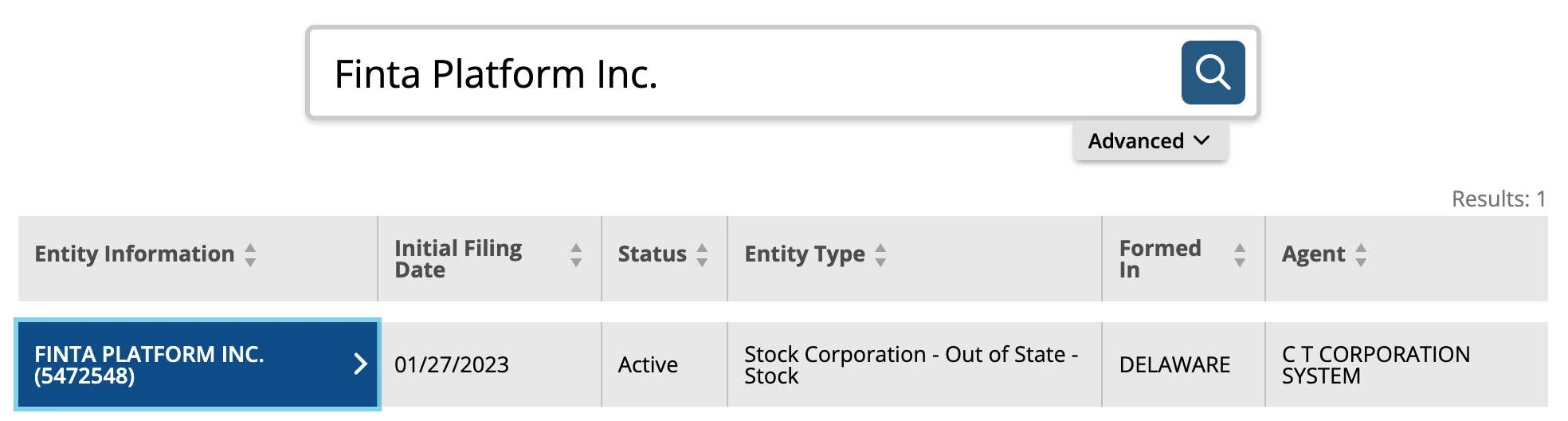
2. Check the due date and start filing
The right panel shows your Statement of Info Due Date. This date is specific to your company based on when you registered, and it’s the same every year.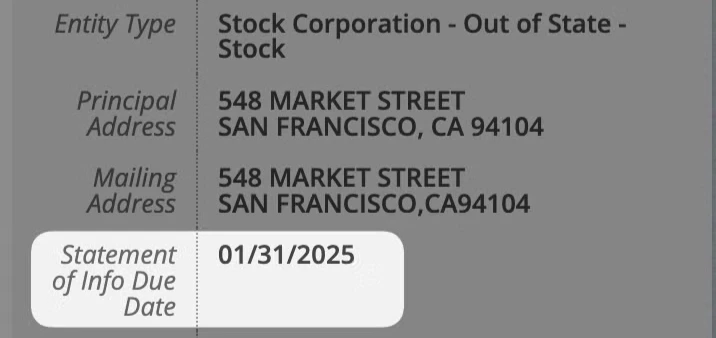
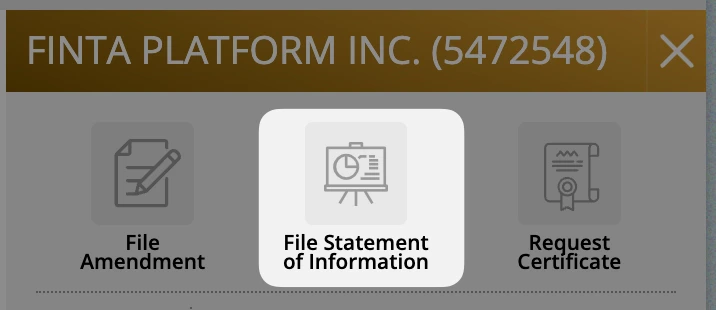
3. Fill out the form and pay
Walk through each step in the sidebar and update anything that changed. Most fields will already be populated from your prior filing.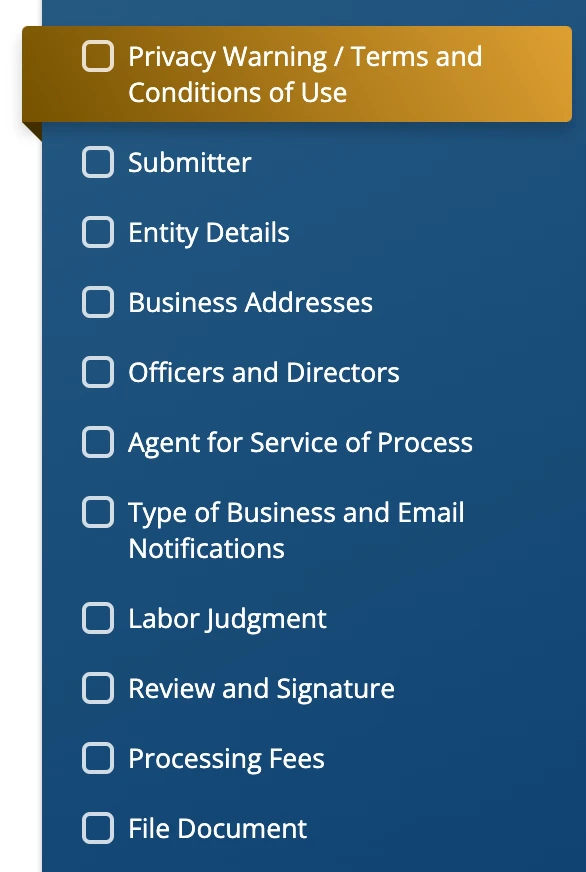
Have questions while filing? Email us and we’ll help you through it.