
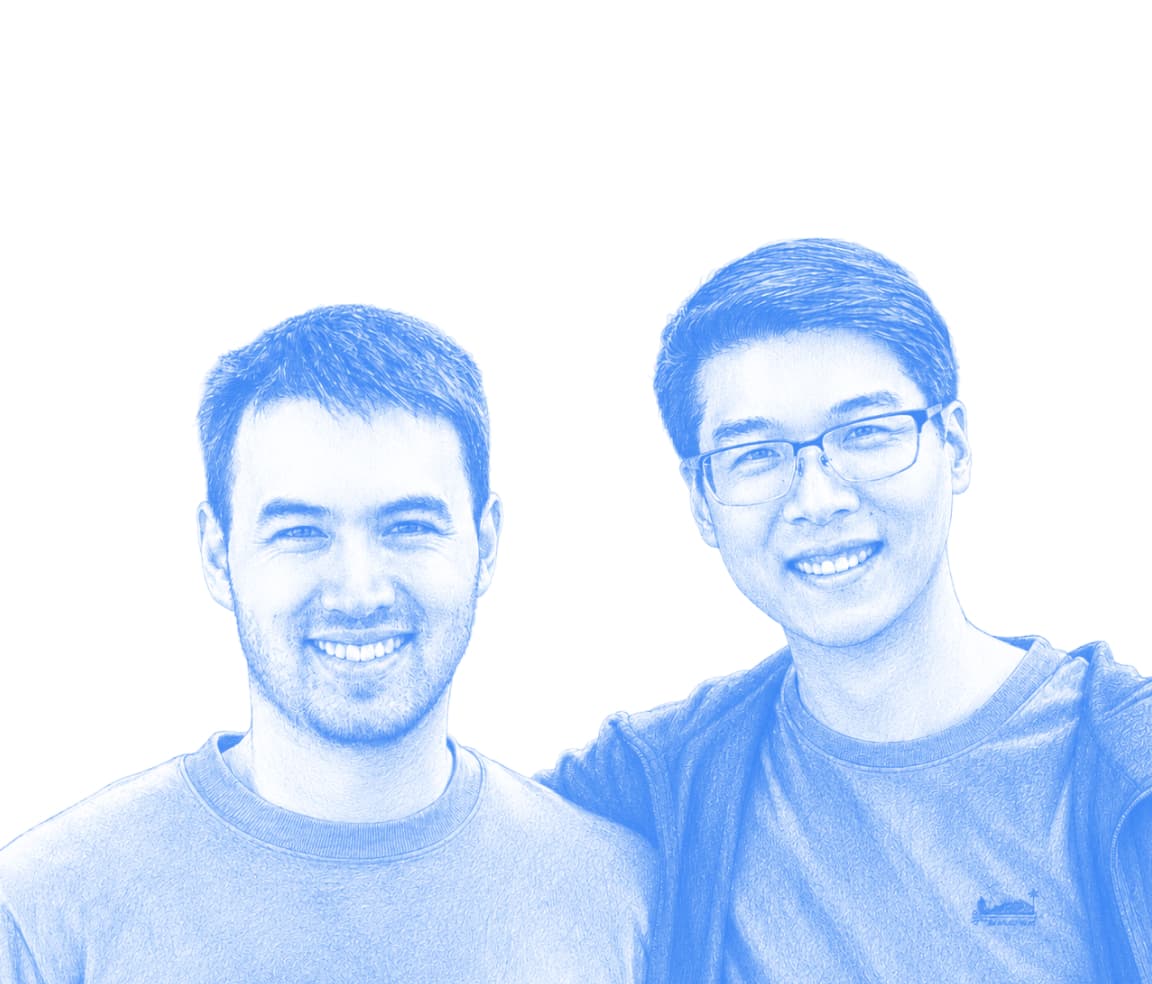
From bio and finance to CS
Yuhong and Chris both studied computer science at UC San Diego, but neither of them started that way. Yuhong came in as a bio major, Chris as a finance major, and both ended up wanting to transfer. For Yuhong, "bio was a lot of memorization. It wasn't hands-on building stuff. I wanted to get more hands-on and do something tangible." At the time, they bonded over the highly competitive process of transferring into CS, which admitted only about 1 in 50 students and required near-perfect grades.
But what really cemented their friendship wasn't the classes. It was the video game League of Legends. Both played the game at a very high level; Chris was once ranked top 100 in North America, and Yuhong wasn't far behind.
After undergrad, Chris did a master's in ML and then worked on the anti-fraud team at Robinhood. Yuhong went straight into industry, first at Cisco, then at Elation, where he worked on natural language SQL using transformer architectures.
The two of them stayed close through playing League and even built a side project together, a tracker that pulled Twitch streamers' live in-game stats so you could see which of your favorite streamers were actually having exciting matches before hopping over to watch. It got community traction. Enough to prove they could ship something together, even if not enough to leave their jobs for.
The ChatGPT moment
In the years after UCSD, Chris kept pitching company ideas. Yuhong had passed on a few of them, either because the space wasn't his lane or because he was busy working at Elation. Onyx was the first idea Yuhong reverse-pitched to Chris.
The timing was unusual. ChatGPT had just launched, and transformers were suddenly the center of gravity in tech. Yuhong was already working on vector search before "RAG" was even a common term. He knew the research on how these models could use more specific data and extract or generate answers directly from it. His bigger question was where that capability would matter most.
"LLMs already know what's on the internet," Yuhong says. "So what does the LLM not know that could be useful?" The answer was company-specific information. Everything sitting in an internal wiki, a Slack channel, a support doc, a ticket queue. Content the LLM had never seen but that people at work needed every day. And that was the beginning of Onyx.
A side project serving enterprises
Onyx was launched as an open-source project through a Hacker News post. The site is known for a critical crowd, but the launch landed well, and companies started to reach out wanting to pay.
The turning point came when a large company approached them about buying enterprise support. They had to explain that neither of them could run a paid software business as a side gig while employed. So they compromised. The enterprise sponsored the open-source project for $500 to cover some of the fees associated with running it.
Around the same time, YC opened an early application track for AI companies. Yuhong and Chris applied. After interviewing with the idea, they got in. Yuhong says, "at that point, you just go."
The truth about the Co-CEO dynamic
Most YC-backed companies have a CEO and a CTO. Onyx had two CEOs. Chris and Yuhong decided from the start to approach the partnership as pure equals.
"YC was really nice about it," Yuhong says. "They didn't push on it at all. They were basically like, just do what works for you." Broadly across the ecosystem, though, co-CEOs are rare. But they made it work even as they scaled. Any context one had, the other had, and every decision was made together.
Yuhong says what made it work wasn't identical wiring; it was complementary wiring. Yuhong wanted to build something a huge number of people would use, something that left a mark. Chris brought the competitive instinct, the drive to win the market. "At the end of the day, both of these play together," Yuhong says. "Even if you have growing usage, if you don't capture the market fast enough, in the end it may not matter. But having not just competition but also a big positive impact on the world is how you keep your company doing good things."
Why PMF is not a static thing
If Yuhong could give one piece of advice to new founders, it would be to try to understand what PMF actually means.
"It's a thing you can have and might lose and gain back at different points," he says. "Even with the same product, depending on your market, if it's moving extremely quickly." The founders who get into trouble are usually the ones who think they have PMF and don't press the gas, or who have it and drift past the window.
Onyx lived through this. Early on, they had strong PMF as an enterprise answer engine, and then the market shifted. Users started asking for custom agents and actions, and a pure answer box began to feel too thin.
"Being an answer machine wasn't enough of a product on its own," Yuhong says. They had to decide whether to become an MCP layer, a search API, or something else entirely. They chose to lean into the open source, stay model-agnostic, and reposition as the knowledge layer for agents.
Onyx became an open-source project with 30,000 GitHub stars, hundreds of thousands of daily deployments, hundreds of thousands of users, and a team of around 20 people.
The Zoom acquisition
Fast forward to now, Zoom is acquiring Onyx. The team, the technology, and the customer base all move over to Zoom, and Onyx becomes the knowledge and search layer inside a product used by hundreds of millions of people every day.
For Yuhong, the excitement about the decision comes down to reach. Onyx spent three years building something that solved a real problem for tens of thousands of companies. With Zoom, that audience turns into millions. The team keeps shipping the same product they've been shipping, but now with enterprise trust and distribution that would have taken years to achieve on their own.
The philosophy that got them here is worth sitting with.
"As a founder, you need to share a vision with the team that's realistic and achievable. That's how you align everyone and maintain the pace, direction, and culture you need. But as a founder, you also need to evaluate every option. Making sure that as opportunities present themselves, if it's the best thing for the team and the product, that you're not stubborn in your ways."
Three years of Onyx taught Yuhong that vision and flexibility are the same discipline. You commit fully to what you're building, and you try to get it into as many hands as possible. For Onyx, that answer turned out to be Zoom.
What comes next
Yuhong is focused on bringing Onyx to Zoom's audience, at Zoom's scale. He also isn't closing the door on doing it again. "This journey has been incredible. If Chris ever wants to embark on another venture further down the line, I'd be more than open to doing it again."
Which is fitting. Onyx started with two friends grinding League of Legends duos, and they decided every version of it together as equals. The Zoom acquisition isn't the end of that pattern. It's the biggest version yet.